
The Tools Behind a Reliable Audio Chain for Live Events
Hannah Doyle
8 min read
Hannah Doyle explains the consoles, cabling, measurement tools and habits we rely on when planning sound for live stages and recorded programmes, and why each one earns its place.
Start with the signal path on paper
Before anyone opens a case of equipment, I draw the signal path from source to speaker on a single sheet. Every microphone, direct box, stage box, console input, processing stage, amplifier and loudspeaker gets a line, and every line gets a label. It sounds basic, but most faults I am called to look at in these late autumn weeks, when venues are busy with indoor events, trace back to a path nobody ever wrote down. The sheet does three jobs. It tells the crew what to patch, it shows where a single failure could silence the whole show, and it gives the venue manager something concrete to approve. I keep it to one page where I can, because a plan that needs a briefing to be understood tends to be ignored on the night.
I work in pencil first and only later tidy the drawing. The early version is for arguing with: could the monitor world share a split with front of house, or does it need its own? Would a second stage box save a long multicore run? Changing a line on paper costs nothing, whereas changing it during load-in costs an hour of everyone's patience. The finished drawing travels with the run sheet, so the sound crew, the stage manager and the person on the front door all work from the same picture of what is plugged into what.
- One page, source to speaker, every link labelled
- Mark single points of failure in a second colour
- Agree the drawing with the venue before load-in
Consoles and why we choose by workflow
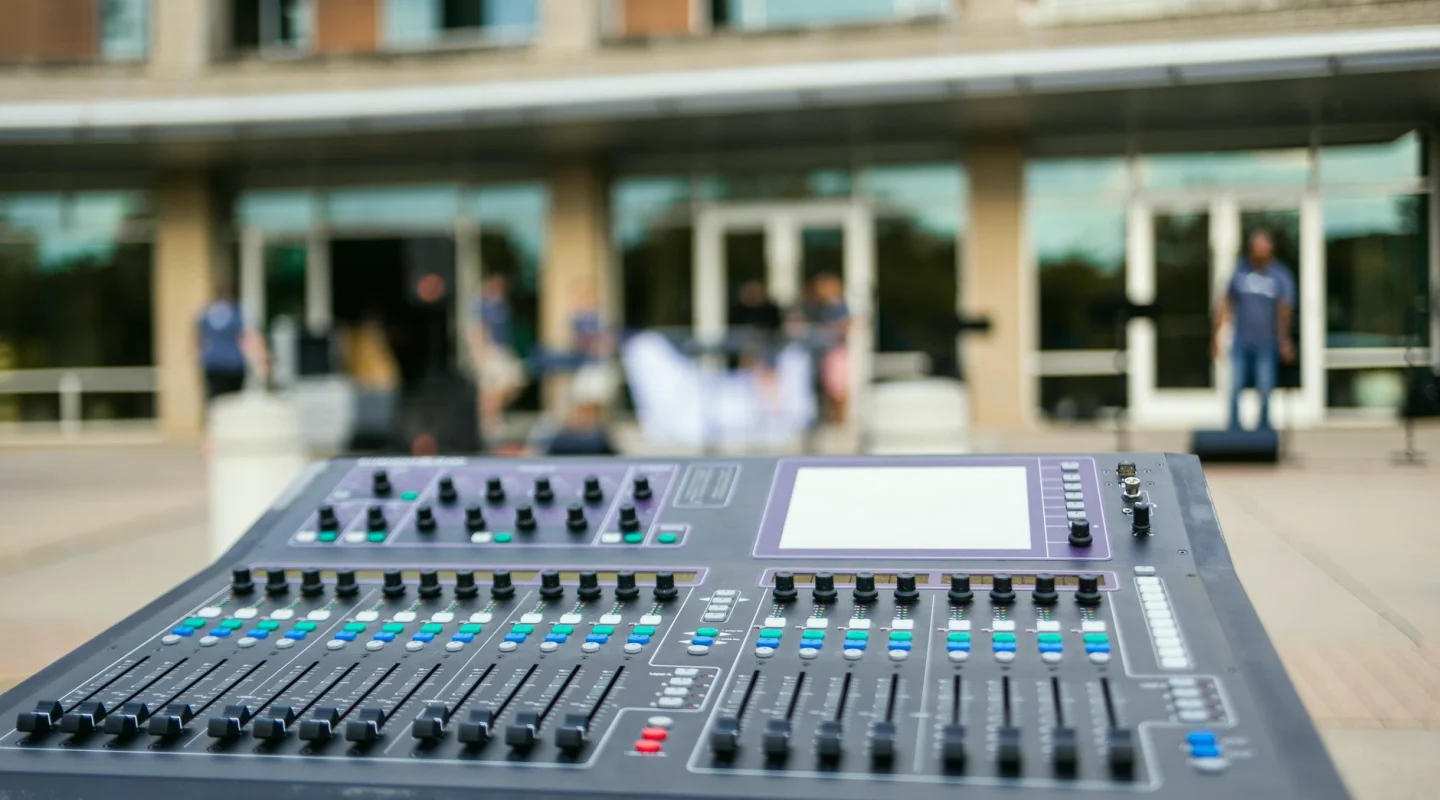
People often ask which console we recommend, and the honest answer is that it depends on who will be mixing and for how long. A touring engineer who knows one desk by heart will mix better on it than on a newer model they have never seen. For recorded programmes with a fixed team, I lean towards desks with good recall and tidy routing, because the same show returns week after week. Size matters less than layout. A compact digital desk with sensible layering often beats a large one where every function hides three menus deep. I ask the mixer to talk me through their usual song or scene, and I watch where their hands go. That tells me far more than a specification sheet.
Digital desks let us save scenes, but a scene is only as good as its notes. I label every saved state with the act or segment, the date and who set it, and I keep a plain text copy of the input list beside it. If a console fails and a replacement of the same model is not to hand, the notes let a different desk be programmed in a fraction of the time. Analogue backup is rarely practical at festival scale, so we plan for recovery rather than pretending nothing will break.
- Match the desk to the engineer who will use it
- Name every saved scene by act, date and author
- Keep a written input list separate from the console
Cabling, splits and the dull parts that matter
Most audio problems I deal with are not exotic. They are a damaged connector, a cable run alongside mains power, or a ground loop introduced by two buildings sharing a supply. For that reason we treat cabling as a method rather than an afterthought. Balanced lines throughout, signal and power kept apart where they cross, and every multicore tested end to end before the doors open. Split systems deserve particular care. When one microphone feeds both front of house and monitors, the transformer isolation of the split protects against hum travelling between the two desks. I would rather carry a proper passive split than save space with a cheaper arrangement that shares a ground.
Labelling is the quiet hero. Coloured tape at both ends of each cable, a matching tag on the stage box channel and the same number on the input list means a fault can be found in seconds instead of minutes. We spend a surprising share of any plan on this, because a crew under pressure does not read small print, but it does follow a colour. Spare cables in each length go in a marked tray, and nobody borrows from it without saying so.
- Test every multicore from stage box to desk
- Keep mains and signal cables apart at crossings
- Number cables, channels and input list identically
Measuring the room instead of guessing at it
A measurement microphone and analysis software are among the least glamorous tools we own, and among the most useful. Before a rig is tuned by ear, we play pink noise and look at how the room answers. A hall with a hard back wall, a studio with a bare floor, a marquee with a flapping roof: each shows up on the screen as peaks and dips that would otherwise be argued about for an hour. We do not chase a flat line at any cost. The aim is to find the problems that no amount of mixing will fix, such as a strong low mid build-up, and deal with them in the speaker processing so the mixer starts from something sensible. Then we listen, with music the engineer knows well.
Measurement also helps with decisions about placement. Moving a speaker stack a metre, or angling it away from a reflective side wall, can change the result more than any equaliser. We check coverage at several seats, not just the one in the centre, because the person standing near the edge of a festival tent paid for the same evening. Where a venue limits level, we use the measurements to show the manager what the room allows, so the conversation rests on figures and not opinion.
- Pink noise and a measurement mic before any tuning
- Fix placement first, equalisation second
- Check coverage at several positions, not one
Monitoring: what performers actually hear
Monitoring is where good plans most often come undone, because the audience never hears it and so nobody checks it. Wedges, in-ear systems and side fills each solve different problems. Wedges are simple but spill sound onto the stage and back into open microphones. In-ears give control and a quieter stage but isolate the performer, so we usually add an ambient microphone feed. We plan monitor mixes with the performers, not for them. A short conversation at soundcheck about what they need to hear first, and what they would happily lose, saves the whole set. Singers usually want themselves and a pitch reference. Drummers often want a click and bass. Presenters on a recorded programme need their producer's talkback clear above everything.
Radio equipment adds its own discipline. Frequencies are scanned at the venue, because a hall on a busy street may have interference we cannot predict from the office. Each transmitter and receiver is named, paired and checked with fresh batteries, and a spare set stays within reach of the engineer. We note which frequencies worked, so the next visit starts with that knowledge instead of a blank page.
- Choose wedges or in-ears by the stage, not fashion
- Ask performers what they need first and what to drop
- Scan radio frequencies on site and log what worked
Habits that keep a show recoverable
Tools matter, but habits decide whether a fault becomes a story or a non-event. We carry spares for the cheap, common failures: connectors, batteries, a spare microphone, a spare in-ear pack. We agree before the show who is allowed to touch what, and who makes the call if something stops. A clear chain of command is worth more than another rack of equipment. We also record the show where we can, with a simple multitrack or a stereo safety feed, even when no recording was requested. If the broadcast feed fails, or a dispute arises about levels, there is a reference to listen to afterwards. It costs little and has settled more questions than any specification.
Finally, we debrief. Ten minutes after the last act, with the crew still in the room, we note what worked, what nearly went wrong and what we would change. Those notes go into the next plan. The list of tools grows slowly, but the list of lessons grows every time, and that is the part I trust most when a new venue sends us a floor plan and a date.
- Carry spares for the cheap, common failures
- Record a safety feed even if nobody asked
- Hold a short debrief while the crew is still there
None of this equipment is unusual, and that is rather the point. A reliable audio chain comes from a drawn signal path, a desk the engineer knows, tested and labelled cabling, a room that has been measured, monitors planned with the performers, and a few habits that keep a fault small. If you are planning a stage or a studio, start with the one-page drawing and build outwards from there.